



Graduation season brings a familiar conversation: how much to give, and what form it should take. For most people, the question settles somewhere between a cash card and a generic gift card. But when a dad or mom has been covering college expenses for four years, or a grandparent wants to properly mark the moment a grandchild completes their degree, $1,000 starts to feel like the right amount. And at the right education level and relationship, it often is.
Whether $1,000 is an appropriate gift depends on two things: your relationship to the graduate and your own financial situation. It is also worth noting that higher amounts come with higher expectations — the person receiving $1,000 will remember it, which means how you give it matters as much as the amount itself. Give what you can afford without strain. This guide covers the etiquette, the options, and the right way to make $1,000 count.
Here is what you need to know:
- $1,000 is appropriate from a parent or grandparent for a college, master’s, or professional-school graduate, and generally too much from an aunt, uncle, sibling, or friend.
- The NRF puts the average graduation gift in 2025 at $119.54, so $1,000 is roughly 8 times the norm. At that level, what you do with it matters.
- Cash is the most popular choice (51% of givers, per NRF), but it rarely becomes a story the grad tells for the next decade.
- Tinggly experience boxes and gift cards at this budget unlock once-in-a-lifetime adventures across 100+ countries, with no expiry date.

- 20,000+ experiences to choose from
- Redeemable in 100+ countries
- $79.20 gift value
- Rated 4.9/5 from 199 reviews
- Trending
- Free digital delivery, or printed box
- Recipient picks their own experience

- 23,000+ experiences to choose from
- Redeemable in 100+ countries
- $159.20 gift value
- Rated 5.0/5 from 271 reviews
- Bestseller
- Free digital delivery, or printed box
- Recipient picks their own experience

- 10,000+ experiences to choose from
- Redeemable in 100+ countries
- $207.20 gift value
- Rated 5.0/5 from 305 reviews
- Trending
- Free digital delivery, or printed box
- Recipient picks their own experience
Is $1,000 a Good Graduation Gift? The Verdict by Relationship

From a parent or grandparent giving for a college milestone, $1,000 is an appropriate and generous graduation gift.
The relationship between giver and recipient is the single most important factor in graduation gift etiquette. A parent who spent four years paying tuition, absorbing the anxiety of finals, and watching their child become an adult has every right to mark the finish line with something substantial. A grandparent honoring the first or only grandchild to earn a degree is in the same position. At $1,000, both are squarely within what etiquette experts and financial guidance sources would call expected and appropriate.
Outside that inner circle, the math changes fast.
Graduation Gift Amounts by Relationship
| Giver | Typical range for a college graduate |
|---|---|
| Parents | $300 — $1,000+ |
| Grandparents | $100 — $500 (up to $1,000 for a milestone grad) |
| Aunt / Uncle | $50 — $250 |
| Sibling | $25 — $100 |
| Close friend | $50 — $100 |
| Coworker/acquaintance | $10 — $50 |
When $1,000 Is Too Much
An aunt or uncle giving $1,000 would be considered well beyond the expected range by virtually every etiquette source. The same applies to a sibling, a close friend, a coworker, or a family friend. If you fall into one of those categories and are considering four figures, the honest answer is: it’s too much, and it may create discomfort for the recipient rather than joy.
One more thing worth saying clearly: the IRS 2025 annual gift tax exclusion is $19,000 per recipient ($38,000 for married couples filing jointly). A $1,000 graduation gift requires no reporting and no tax filing from either party. That concern can be put aside entirely.
What $1,000 Looks Like as a Graduation Gift — Four Options

Knowing the amount is appropriate is only half the decision. The other half is what $1,000 actually does when you hand it over.
Cash
Cash is the most popular graduation gift for a reason: the grad sets the priority. According to NRF data, 51% of givers choose cash, and personal finance communities confirm where it tends to land — an emergency fund in a high-yield savings account, student debt repayment, or a Roth IRA contribution if the grad has earned income. All of those are genuinely useful. None of them is a story.
Savings Bonds and 529 Contributions
A savings bond or a contribution to a 529 account works well for younger grads or those heading into further education. The financial logic is sound. The emotional distance is real. This option lands better as a complement to a more experiential gift than as the sole gesture.
Stock or Brokerage Contributions
For a financially engaged grad with earned income, contributing to a brokerage account is meaningful in the long run. Like a savings bond, it is invisible for years. Better as a supplement than a centerpiece.
Experience Gifts at the $1,000 Level
This is the option with the highest emotional return at this budget. A $1,000 experience gift does not sit in an account. It gets used. It becomes a memory the grad associates with you specifically — which, for a parent or grandparent, is exactly the point.
Specific options at Tinggly at this budget level are covered in the next section. For now, consider the framing: for a gift this size, the question worth asking is not just whether it is appropriate, but whether it will be remembered.
Why $1,000 of Experiences Outlasts $1,000 of Cash
The case for experiences is not intuition. It is research.
Cornell psychologist Dr. Thomas Gilovich has spent more than 20 years studying what makes people happy. His consistent finding: experiences create more lasting happiness than material purchases or cash. Possessions fade into the background of daily life. Experiences become part of personal identity. They are also more resistant to regret — people almost never wish they had skipped the trip.
A 2016 study by Cindy Chan at the University of Toronto added a layer that matters specifically to parents and grandparents. Experiential gifts strengthen the relationship between giver and recipient more than material gifts do. The grad who receives $1,000 for a weekend in Portugal associates that trip with you. The grad who receives $1,000 in cash associates it with their emergency fund.
The generational data points in the same direction. Eventbrite research shows 78% of Millennials and 74% of Gen Z prefer spending on experiences over possessions. The grad who receives cash is, statistically, more likely to use it on a high-yield savings account than on a hot-air balloon flight over Cappadocia.
The practical argument runs the same way. $1,000 in a high-yield savings account earns roughly $45 a year. $1,000 spent on a once-in-a-lifetime experience earns a story the grad will still be telling at 35.
A savings deposit is not a story.
The Best $1,000 Graduation Experience Gifts from Tinggly
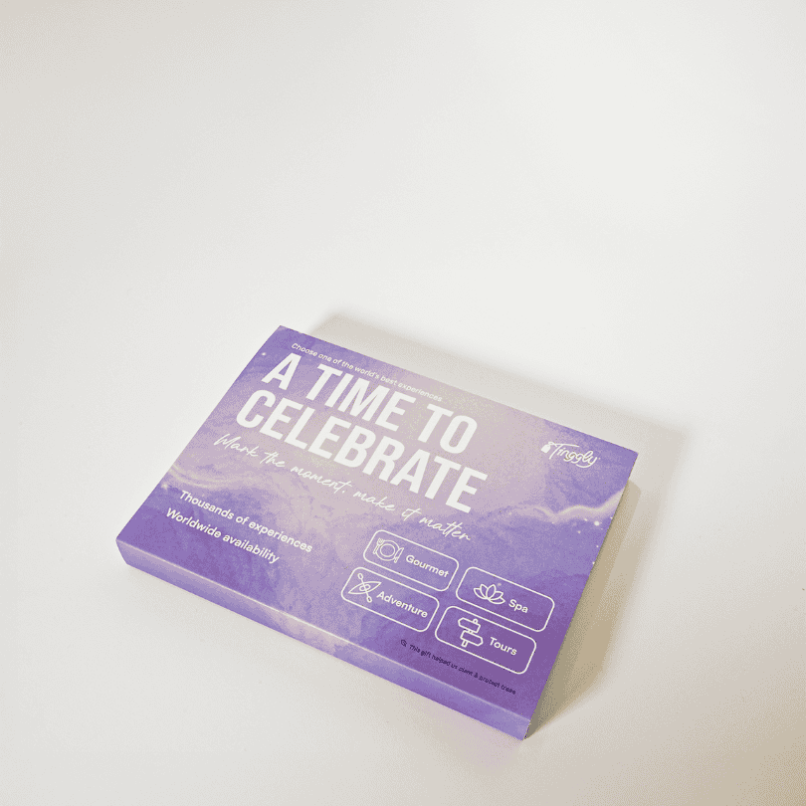
Knowing experiences win on emotional return is one thing. Knowing what to actually buy is another. Here is what $1,000 unlocks at Tinggly specifically.
Tinggly Gift Card (Custom Amount)
Best for: givers who want the grad to choose freely.
A Tinggly e-gift card issued for exactly $1,000 is the most flexible version of this gift. It is delivered instantly by email, is redeemable for any experience in 100+ countries, and has no expiry date. The grad decides when, where, and what — a coastal sailing weekend, a private cookery class in Tuscany, or a bucket-list safari moment they would never book for themselves. This is the recommended option for a parent who wants the full $1,000 to stay in play without restriction.
Once in a Lifetime Experience Box
Best for: givers who want something to unwrap at the ceremony.
The Once in a Lifetime box is priced at $649 and contains 50 curated extraordinary experiences worldwide — think private helicopter tours, supercar driving days, glamping in the Serengeti, or a sailing weekend on the Adriatic. As a standalone gift at this tier, it leaves $350 in change that can go toward a second experience or a cash top-up.
Hotel Getaway Gift
Best for: grads moving to a new city or planning a gap year.
At $999, the Hotel Getaway gift is Tinggly’s highest-priced curated box and unlocks premium hotel stays in 57 countries. For grads who are about to relocate, start a demanding job, or use the months after graduation to travel, this offers a ready-to-use escape with no planning friction.
The Physical Box Plus Gift Card Combination
Best for: givers who want both a tangible gift moment and full flexibility.
Pair a Graduation Adventure box ($99) with a custom Tinggly gift card ($900), and you get the best of both: a beautifully packaged physical box the grad can receive at the ceremony, plus the practical flexibility of a $900 digital credit they can put toward any experience they choose. The box is the moment; the card is the freedom.
How to Pool $1,000 as a Group Gift
Best for: families combining contributions from multiple relatives.
$1,000 from parents, grandparents, and aunts or uncles pooled into a single Tinggly gift card gives the grad the budget to choose something they would genuinely never book alone — a private villa weekend, a multi-day sailing trip, or a premium food and wine experience in a destination they have always wanted to visit. Tinggly’s gift card handles pooled amounts cleanly, and the grad redeems it in one place.
Tinggly works simply: one box or one gift card, thousands of experiences to choose from across 100+ countries, and no expiry date. The grad books will be ready when they are. Discover the full range of graduation experience gifts at Tinggly.
How Much to Give for Graduation by Relationship and Degree
The relationship matrix above covers the core framework. Degree level adds a layer of nuance worth acknowledging.
For High School Graduation
From a parent, $1,000 for high school graduation is on the high end but not inappropriate — particularly when the gift is earmarked for a specific purpose. A college setup fund, a gap-year trip, or a contribution toward a first major experience all give the amount a clear meaning. Without that framing, $1,000 in cash can feel abstract to a 17- or 18-year-old and is more likely to be spent on day-to-day expenses than to serve as a genuine milestone gift.
From anyone other than a parent, $1,000 for high school graduation would be considered unusually large by most etiquette standards. The relationship matrix in the opening section applies.
For College Graduation
$1,000 from a parent or grandparent is squarely appropriate for a college graduate. It acknowledges four or more years of tuition, sacrifice, and growth without being ostentatious. Etiquette experts, including Emily Post and Diane Gottsman, consistently emphasize that the relationship and the giver’s personal financial means matter more than any specific number. Give what you can without financial strain — $1,000 from a comfortable parent is appropriate; $1,000 stretched from a tight budget is not necessary.
For Graduate and Professional School
For an MBA, JD, MD, or other advanced degree, $1,000 from a parent is appropriate and reflects the extended academic investment. From a grandparent, $1,000 is reasonable for a milestone of this scale. The extended timeline of graduate school — and the debt that often accompanies it — makes a generous gift feel more earned, not less.
The Bottom Line
Celebrating a graduation is one of the clearest opportunities to give a gift that carries real weight. Most people who are asking whether $1,000 is a good graduation gift already sense the answer — they just want confirmation that the amount fits the relationship, and an idea that does justice to the person they are celebrating.
If you are a parent or grandparent giving for a college or advanced degree, $1,000 is the right amount. The remaining question is how to give it in a way that has a lasting impact. Giving cash offers practical value and helps a grad manage expenses, but for most graduates, it quietly goes toward costs they were already planning to cover — student loan repayments, moving bills, and a few weeks of runway before the first paycheck. That is not a bad outcome. It just rarely becomes the gift they mention a year later.
An experiential gift gives the same money a story, a destination, and a memory connected directly to the person who gave it. That is the difference between financial support and a future the grad gets excited about. Close relatives who have watched this person work for years deserve to be part of that moment — not just the balance sheet.
Tinggly makes it straightforward. A custom gift card at exactly $1,000, a curated experience box, or a pooled contribution from the whole family, whatever form works best, and the graduate chooses their own adventure across 100+ countries, at their own pace, with no expiry date. No pressure to book in the first weeks. No gift that sits unopened. Just a once-in-a-lifetime experience waiting for the right moment.
Browse graduation experience gifts at Tinggly and find the option that fits.
Frequently Asked Questions
Is $1,000 a good college graduation gift?
Yes, from a parent or grandparent for a college graduate. $1,000 sits at the upper end of the expected parent range ($300 to $1,000+) and is roughly 8 times the 2025 national average of $119.54 (NRF). From an aunt, uncle, sibling, or friend, $1,000 would be considered well beyond expected norms. The relationship is the primary factor, not the degree type.
What is the average graduation gift amount in 2026?
The average graduation gift in 2025 was $119.54, with total US spending reaching $6.8 billion (NRF 2025 graduation survey). Of that spending, 51% of givers chose cash, and 34% gave gift cards. $1,000 is approximately 8 times the national average, placing it firmly in the milestone-gift category rather than the standard-occasion range.
Is $500 a good graduation gift?
Yes. $500 is a generous and widely appropriate graduation gift from a parent or close family member for a college graduate. It sits at the top of the range recommended by US News etiquette experts ($100 to $500) and is roughly 4 times the 2025 national average. From a grandparent giving for a college milestone, $500 is also considered appropriate and generous by most etiquette standards.
Do you have to pay gift tax on a $1,000 graduation gift?
No. The IRS 2025 annual gift tax exclusion is $19,000 per recipient ($38,000 for married couples filing jointly). A $1,000 graduation gift is well below the threshold and requires no reporting or tax filing from either the giver or the recipient. For personal tax situations that go beyond this general guidance, consult a tax professional.
What should a graduate do with $1,000?
Personal finance communities consistently recommend putting the bulk of a $1,000 gift to work: an emergency fund in a high-yield savings account, a Roth IRA contribution for grads with earned income, or paying down high-interest student debt. Those are all sound choices. The part of the equation that often gets overlooked is reserving a portion for something enjoyable. $100 to $200 of a $1,000 graduation gift spent on a memorable experience often creates more lasting satisfaction than the full amount sitting in savings, and does not meaningfully affect the financial plan.
Is $1,000 too much for a high school graduation gift?
From a parent, no — provided the gift has a clear purpose. A college setup fund, a gap-year trip, or a first significant experience gives the amount meaning and prevents it from disappearing into a teenager’s everyday spending. Without that framing, cash at this level can feel abstract at 17 or 18. From anyone other than a parent, $1,000 for high school graduation would be considered unusually large by most etiquette standards. See the full range of ideas for high school graduation gifts if you are looking for something more tangible than a cash envelope.