

No expiration date
Easy refund
Free exchange
Easy booking
Borjomi Tour from Tbilisi with Bakuriani Resort and Soviet Train Ride
 Tbilisi, Georgia, Europe
$275
This is an experience gift voucher. The recipient will book the experience after
they redeem the gift voucher.
Overview
Visiting Borjomi and Bakuriani offers a unique opportunity to experience a balneological resort famous for its mineral water park and a winter and summer retreat nestled in forests at 1,700 meters elevation. Guests will travel on the Soviet train Kukushka, which connects these two destinations through scenic landscapes.
- 🚂 Guests will take the Kukushka train on a narrow-gauge railway through deep forests.
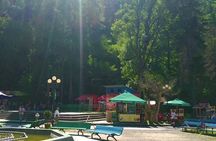
- 🌲 Relax and enjoy nature at Borjomi Central Park, including tasting the mineral water.
- 🏰 Visit the Mtsvane Monastery, built in the 10th century and surrounded by greenery.
- 🎟️ Entry tickets to the train and central park are included in the tour.
- ⚠️ The total drive covers 370 km (230 miles); ensure you are prepared for this distance.
To keep your travel plans flexible, Tinggly prioritizes sustainability first, provides instant digital delivery, ensures no expiry, and offers a worldwide selection.
—
The experience offers several options. This price includes:
Standard Tour
Pickup included
Pickup included
Tour guide
Language: English
Human tour guide
Duration: 12 hours
The experience offers several options, check yours above
- Air-conditioned vehicle
- WiFi on board
- Bottled water
- Private transportation
- Lunch
-
Railway "Kukushka" (Russian "little cuckoo") is a 37.2-kilometre narrow-gauge railway line linking the town of Borjomi (820 m asl) to the village and ski resort of Bakuriani (1,700 m asl). The construction of this 900 mm line began in 1897, when Georgia was still part of the Russian Empire. The difficult terrain caused construction to take four years, and the first train ran in January 1902. Gustave Eiffel was commissioned by the Romanovs to design the bridge over the Tsemistskhali River between the stations of Tsaghveri and Tsemi. Originally, trains were pulled by a steam engine of the "Porter" type, imported from America, and passengers travelled in open carriages protected by handrails. The line was electrified in 1966, when the small steam engine was replaced by an electric "crocodile" locomotive made by the Škoda works in Czechoslovakia. Travel time is 2.5 hours (average speed 15 km/h).
-
BakurianiBakuriani is a village and a skiing resort located at an elevation of 1,700 meters above sea level. The region around Bakuriani is covered by coniferous forests (mainly made up of spruce). The present-day area of the town was built up by lava flows from the nearby Mukhera volcano. The ski area of the resort is split into two separate parts: Didveli and Kokhta/Kokhta-Mitarbi. Mount Kokhta provides a maximum skiable altitude of 2,269 metres, whereas the highest lift in Didveli reaches 2,702 metres.
-
Borjomi Central ParkBorjomi is a resort town with a population of 10,546 and is a balneological and climatic resort. Borjomi has several districts, of which Likani, Papa and Plateau are particularly favorable for treatment. The main treatment of the resort is mineral water used for drinking and balneological procedures. Other treatment factors in Borjomi are climatotherapy, mud treatment. The best time for climatotherapy is June-October. Medical indications: chronic diseases of the gastrointestinal tract, liver and biliary tract, alteration of substances, some diseases of the cardiovascular system. The season lasts all year. Borjomi has striking nature and unique mineral waters. One of the best places visit is the “Mineral Water Park”. The park itself dates back to the 1850s and is an attractive destination all throughout the year. Here you can taste the natural Borjomi mineral water and relax in a beautiful environment.
-
Green (Mtsvane) MonasteryThe Chitakhevi church of Saint George is a medieval church. Abandoned for more than two hundred years, the monastery was restored in 2003.The monastery's history is unknown. An upsurge in pilgrimage followed, driven by a belief that stones in the nearby stream acquired a reddish colour after a massacre of local monks by the soldiers of the Persian shah Tahmasp I in the 1550s. The Monastery consists of a three-nave basilica, stylistically dated to the late 9th or 10th century, and a two-storey bell-tower, likewise dated to the 15th or 16th century. There are remnants of old monastic cells and some accessory structures nearby. The church is built of coarsely hewn ashlar and rubble. Both the internal and external walls are plain, devoid of any significant decoration; traces of frescoes, probably executed in the 12th or 13th century, survive in the apse and on the west wall. A bell-tower stands a few metres southeast of the church. It is a two-storey structure.
If it’s canceled due to poor weather, you’ll be offered a different date or a full refund.
How it works?
01
—
You choose from 10,000+ experience gifts
02
—
We deliver the eVoucher or the Physical box to the recipient
03
—
Recipient books the experience and creates unforgettable memories!
Borjomi Tour from Tbilisi with Bakuriani Resort and Soviet Train Ride
Tbilisi, Georgia, Europe
$275
This is an experience gift voucher. The recipient will book the experience after
they redeem the gift voucher.
How it works?
01
—
You choose from 10,000+ experience gifts
02
—
We deliver the eVoucher or the Physical box to the recipient
03
—
Recipient books the experience and creates unforgettable memories!