

No expiration date
Easy refund
Free exchange
Easy booking
Casablanca Half Day City Tour
 Casablanca, Atlantic Coast, Morocco
$216.52
This is an experience gift voucher. The recipient will book the experience after
they redeem the gift voucher.
Overview
The Casablanca Half Day City Tour offers an insightful glimpse into Morocco's economic capital. With a unique blend of modernity and culture, this tour highlights the city's architectural wonders and rich history.
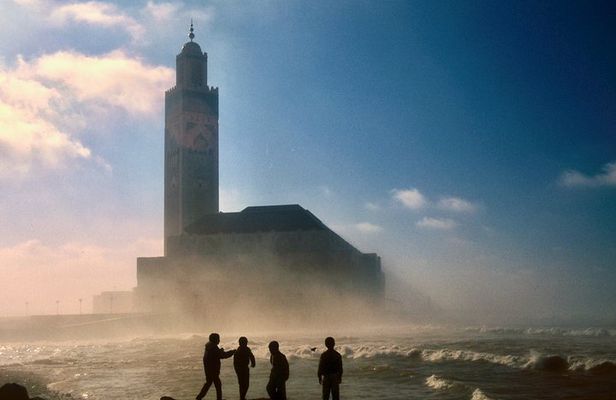
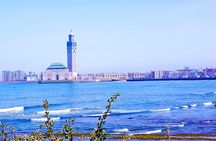
- 🏛️ Visit the stunning Hassan II Mosque, the largest in Morocco and seventh largest globally, with a capacity of 25,000 worshippers inside and 80,000 in the courtyard. Entrance fee is approximately USD 14, with limited interior visits available on Fridays and religious holidays.
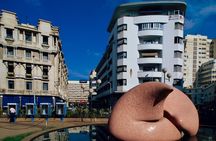
- 🌆 Marvel at Casablanca's impressive Art Deco architecture, showcasing the city's rich heritage and vibrant urban landscape as you navigate its streets.
- 🕌 Explore the Place des Nations Unies, a revitalized public space that serves as the city's "living room," featuring palm trees and a blend of modern and historical design elements.
- 🚶♂️ Pass by the Mahkama Du Pacha, a masterpiece of Moroccan craftsmanship, which once served as the reception halls for the Pasha of Casablanca and now functions as a government building.
- 🏡 Stroll through the Quartier Habous, where French colonial architecture meets Moroccan details, designed for a traditional Muslim lifestyle with mosques, markets, and public bakeries.
- 🌊 Enjoy the refreshing Atlantic breeze along Casablanca's Corniche, with opportunities to stop at cafes and restaurants on the scenic "Aid Diab" stretch.
- 🚐 Benefit from hotel pick-up and drop-off, ensuring a comfortable and convenient start and finish to your tour.
- 💧 Stay refreshed with complimentary bottled water provided throughout the tour.
- 👶 Specialized infant seats are available for families traveling with young children.
For those seeking to share memorable adventures, Tinggly offers a sustainable gifting option with instant e-delivery, no expiration on vouchers, and a world of experiences to choose from.
—
Casablanca Half Day City Tour
Pickup included
Pickup included
Tour guide
Language: English
Human tour guide
Duration: 3 hours 30 minutes
- Spot Private Tour Guide
- Admission Fees
- Hotel Pick-Up & Drop-Off
- Air-conditioned vehicle
- Bottled water
- Private transportation
- Tour Guide and Driver
- Hassan II Mosque
- Lunch
-
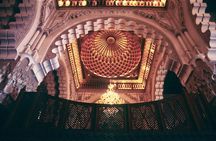
Hassan II MosqueOutside visit of the Hassan II Mosque, the largest mosque in Morocco and seventh largest in entire world. It has capacity to host twenty five thousands of devotee in its hall and almost eighty thousands of worshippers will be easily accommodate at its courtyard. All most eight hundred million dollars have spent to build this masterpiece and it is considered as the second largest religious building in the entire planet. Most of the essential part of this mosque including minaret, royal doors and dome, are made from marble. Its breath-taking view is truly unforgettable in life. The Hassan II Mosque is the unique Mosque that can be visited by non Muslims. Entrance fee: about USD 14. (The interior visit lasts 1 hour with a fixed time slots. Limited visits on Friday and on religious holidays)
- Imagined as the commercial heart and the communication hub of the city. In addition, with the desire to revitalize public spaces, the Place des Nations Unies is regularly the theater Place des Nations Unies (Formerly Place de France). Designed as the airlock of the city, it is the "vestibule" of the administrative place, this one being regarded as the "living room" of the city. Planted from its origin with ficus (Ficus benjamina) in order to make travelers' expectations more comfortable thanks to a set of shadows, the square was redesigned in 2012 to accommodate the first tram line. This is how rows of Phoenix canariensis palm trees embellish the site, alongside the renovation of the floors, which consists of a clever alternation of concrete and old paves of cultural, improvised or institutional events. (pass by)
- Built in 1920s and designed by the French Architect Henri Prost, formerly the Administrative Place or the Grand Place, it is largely inspired by the place Stanislas in Nancy, as evidenced by the layout of the buildings and their location, as well as the esplanades planted with ficus. Similarly, the Royal Palace in Paris greatly influenced its design, as demonstrated by the use of the galleries, the distancing of the facades by alignments of trees, the nesting of the square and the rectangle in the composition of the space, and the desire to make it a living place with the installation of cafes and restaurants. In 1925, while he was on a city tour for engineers and writers at the occasion of the inauguration of the rail line connecting Rabat to Casablanca, Hubert Lyautey presents the Administrative square in these terms: "All that was camps ... here, I wanted to do something like the garden of the Palais - Royal ... a flowered square, framed by long symmetrical buildings. (pass by)
-
Mahkama Du PachaThe most important building in the nablus quarter, built between 1941 and 1952, signed Auguste Cadet, this big court a veritable masterpiece of Moroccan Artisanat. The Mahkama formerly housed the reception halls of the Pasha of Casablanca, as well as Muslim courthouse covering a space of 6200 sum, including 6 Halls of 64 big salons, offices and several galleries. The building is actually used as a governmental administration.
- Built by the Sultan Moulay Youssef on 1923, it is the first Mosque erected by Auguste Cadet. The Minaret, is the Almouhade style, and its similar to Al Koutoubia Mosque in Marrakech and the Seville's Giralda. (pass by)
-
Quartier HabousBuilt by the French colonial and designed by the French architect and urban planner "Henri Prost" at the beginning of the 20th century, after the arrival of the Protectorat. The Quartier Habous; is a mixture of the French architecture with the Moroccan Details. It was designed to fit the Muslims lifestyle, this is why we find inside Mosques, madrassas, markets, public bakery, Kissarias (gallery of Shops), and Moroccan houses where the style was picked from Fez and Marrakech architecture.
- Take a walk by the Casablanca's Corniche to feel the Atlantic Cost breeze. If you time permits, you may experience one of the coffee and Restaurants along-way of the "Aid Diab" Corniche. (pass by)
How it works?
01
—
You choose from 10,000+ experience gifts
02
—
We deliver the eVoucher or the Physical box to the recipient
03
—
Recipient books the experience and creates unforgettable memories!
Casablanca Half Day City Tour
Casablanca, Atlantic Coast, Morocco
$216.52
This is an experience gift voucher. The recipient will book the experience after
they redeem the gift voucher.
How it works?
01
—
You choose from 10,000+ experience gifts
02
—
We deliver the eVoucher or the Physical box to the recipient
03
—
Recipient books the experience and creates unforgettable memories!