

No expiration date
Easy refund
Free exchange
Easy booking
Mycenae Ancient Corinth and Isthmus Canal Private Tour
 Athens, Greece, Europe
$378.04
This is an experience gift voucher. The recipient will book the experience after
they redeem the gift voucher.
Overview
This private day trip from Athens offers a thoughtfully crafted Greek experience through ancient history and mythology. Visit significant landmarks such as the Corinth Canal and the legendary ruins of Mycenae.
- 🌊 The Corinth Canal connects the Gulf of Corinth to the Saronic Gulf, separating the Greek mainland from the Peloponnese and showcasing a remarkable feat of ancient engineering.
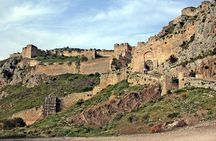
- 🏛️ Ancient Corinth is a historically rich area, inhabited since prehistoric times, featuring significant archaeological sites like the Acrocorinth hill fortress and various Roman and early Christian monuments.
- 🏺 The Archaeological Museum of Corinth houses an impressive collection of artifacts, including statues, mosaics, and pottery, providing insight into the daily life of ancient Corinth.
- ⛪ The Temple of Apollo stands as one of Greece's oldest Doric temples, dating back to the 6th century BC, with seven massive columns still intact, symbolizing ancient Corinth's wealth.
- 🐅 Mycenae was a major center of the Mycenaean civilization, famed for its Lion Gate and royal tombs, offering a glimpse into the legendary kingdom of Agamemnon.
- 📜 The Archaeological Site of Mycenae features the iconic Lion Gate and the remains of Agamemnon's palace, making it one of Greece's most significant prehistoric archaeological sites.
- 💍 The Archaeological Museum of Mycenae showcases key findings from the Mycenaean era, including jewelry, frescoes, and everyday objects, enriching your understanding of this ancient civilization.
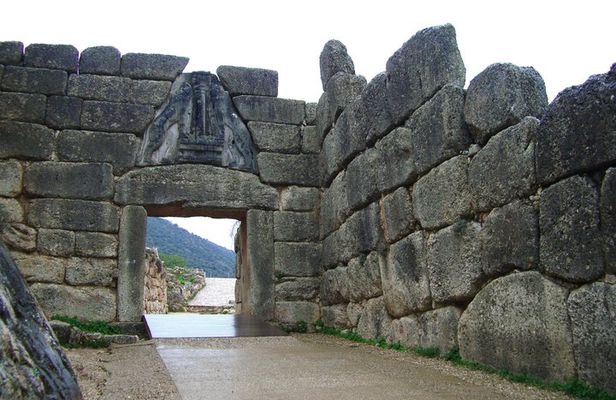
- 🦁 The Lion Gate is the main entrance of Mycenae's citadel, adorned with a unique relief sculpture of lions, marking it as a significant monument of prehistoric Aegean art.
- ⚱️ The Treasury of Atreus, also known as the Tomb of Agamemnon, is a monumental tholos tomb that exemplifies Mycenaean engineering prowess and is a key attraction in the region.
- 🚐 Pickup included from your Athens hotel or Piraeus port in an air-conditioned vehicle, ensuring a comfortable journey throughout the day.
Tinggly offers a sustainable way to share unforgettable experiences like this Greek adventure. With instant e-delivery and no expiration on vouchers, your loved ones can enjoy this journey at their convenience, all while choosing from a global selection of exciting activities.
—
Corinth,Mycenae & Canal
Pickup included
Pickup included
Tour guide
Language: English
Human tour guide
- Fluent english speaking drivers
- Air-conditioned vehicle
- Athens hotel/ Piraeus port pickup and drop-off
- Professional drivers with deep knowledge of history (Not licensed to accompany you in any site)
- Bottled water
- WiFi on board
- Private transportation
- Archaelogical Site Of Ancient Corinth €15.00 per person
- Entry/Admission - Archaeological Site Mycenae
-
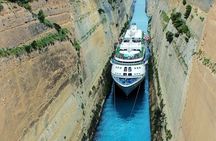
Corinth CanalThe Corinth Canal is a waterway that crosses the narrow isthmus of Corinth to link the Gulf of Corinth to the Saronic Gulf. As such, the canal separates the Greek mainland from the Peloponnese, turning it into an island. It is believed that Periander, the tyrant of Corinth (602 BC), was the first to conceive of the idea of digging the Corinth Canal. As the project was too complicated given the limited technical capabilities of the times, Periander constructed the diolkos, a stone road which allowed ships to be transferred on wheeled platforms. In ancient times, this was a solid land crossing—used by travelers, merchants, and even the Apostle Paul during his journeys to Corinth.
- The area of Ancient Corinth is one of the most historically important regions of Greece, inhabited continuously from prehistoric times to the Roman and early Christian periods. Due to its strategic location between mainland Greece and the Peloponnese, Corinth became a powerful city-state and a major commercial center of the ancient world. The region includes important archaeological sites such as the ancient city of Corinth, the Acrocorinth hill fortress, the ancient port of Lechaion, and several Roman and early Christian monuments, making the area a place of great archaeological and historical significance. Ancient Corinth was one of the largest and most important cities of Greece, with a population of 90,000 in 400 BC. The Romans demolished Corinth in 146 BC, built a new city in its place in 44 BC, and later made it the provincial capital of Greece. (pass by)
-
Archaeological Museum of CorinthThe Archaeological Museum of Ancient Corinth houses important findings from the ancient city of Corinth, covering periods from prehistoric times to the Roman and early Christian eras. The collection includes statues, mosaics, pottery, everyday objects, and Roman sculptures that reveal the wealth and importance of ancient Corinth as a major Greek and Roman city. The museum visit helps visitors better understand the history and daily life of the ancient city before exploring the archaeological site.
-
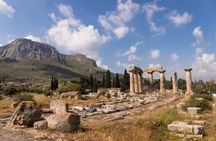
Temple of ApolloThe Temple of Apollo (Ancient Corinth) is one of the oldest Doric temples in Greece, dating back to the 6th century BC. Built on a hill overlooking the ancient city, the temple was dedicated to Apollo and symbolized the power and wealth of ancient Corinth. Today, seven of its massive monolithic columns still stand, offering visitors a striking view and a strong connection to the ancient Greek world.
- Mycenae was one of the most important centers of the Mycenaean civilization, which dominated Greece during the late Bronze Age (1600–1100 BC). The archaeological site is famous for the Lion Gate, the Cyclopean walls, the royal tombs, and the Treasury of Atreus, all connected with the legendary king Agamemnon and the Trojan War. Today, Mycenae is a UNESCO World Heritage Site and one of the most significant archaeological destinations in Greece, offering visitors a unique view into prehistoric Greek civilization. (pass by)
-
Archaeological Site MycenaeThe Archaeological Site of Mycenae is one of the most important prehistoric archaeological sites in Greece, dating back to the Mycenaean civilization of the late Bronze Age. The site includes the famous Lion Gate, the massive Cyclopean walls, royal tombs, and the remains of the palace of Agamemnon. Mycenae is closely connected with Greek mythology and the Trojan War and is today a UNESCO World Heritage Site, offering a unique insight into one of the earliest advanced civilizations in Europe.
-
Archaeological Museum of Ancient MycenaeThe Archaeological Museum of Mycenae presents important findings from the Mycenaean civilization, including pottery, tools, jewelry, frescoes, and everyday objects discovered in the royal tombs and the ancient city. The museum helps visitors understand the history, culture, and daily life of the Mycenaean world and provides important context before or after exploring the archaeological site of Mycenae.
-
Lion GateThe Lion Gate was the main entrance of the Bronze Age citadel of Mycenae, southern Greece. It was erected during the 13th century BC, around 1250 BC, in the northwest side of the acropolis and is named after the relief sculpture of two lionesses or lions in a heraldic pose that stands above the entrance. The Lion Gate is the sole surviving monumental piece of Mycenaean sculpture, as well as the largest sculpture in the prehistoric Aegean. It is the only monument of Bronze Age Greece to bear an iconographic motif that survived without being buried underground, and the only relief image which was described in the literature of classical antiquity, such that it was well known prior to modern archaeology.
-
The Treasury of Atreus, also known as the Tomb of Agamemnon, is one of the most impressive monumental tombs of the Mycenaean civilization, dating back to the 13th century BC. This massive tholos tomb, built with enormous stone blocks, demonstrates the power and engineering skill of Mycenaean Greece and is considered one of the most remarkable prehistoric monuments in Europe.
If it’s canceled due to poor weather, you’ll be offered a different date or a full refund.
How it works?
01
—
You choose from 10,000+ experience gifts
02
—
We deliver the eVoucher or the Physical box to the recipient
03
—
Recipient books the experience and creates unforgettable memories!
Mycenae Ancient Corinth and Isthmus Canal Private Tour
Athens, Greece, Europe
$378.04
This is an experience gift voucher. The recipient will book the experience after
they redeem the gift voucher.
How it works?
01
—
You choose from 10,000+ experience gifts
02
—
We deliver the eVoucher or the Physical box to the recipient
03
—
Recipient books the experience and creates unforgettable memories!