

No expiration date
Easy refund
Free exchange
Easy booking
Beat The Heat in Athens Local Food and Sightseeing Walking Tour
 Athens, Greece, Europe
$90.31
This is an experience gift voucher. The recipient will book the experience after
they redeem the gift voucher.
Overview
litmomentsgr.com
Athens Unfiltered: Sightseeing & Full Culinary Journey
Why choose between highlights and authentic food when you can have both? This tour combines a city walk past top landmarks with a complete, non-stop tasting experience.
* Effortless Sightseeing: See the Acropolis from a viewpoint, pass by Parliament and Plaka, and get the essentials without boring lectures or wasting hours in line.
* The Full Food Experience: Start with authentic street snacks, Greek coffee and local bites along the walk, leading up to a serious, sit-down feast with rich traditional dishes and dessert.
* No Tourist Traps: Discover genuine spots handpicked by locals, giving you the real flavor and pulse of Athens in one smooth tour.
See the city, taste the real food, leave completely full. Book your spot today!
—
Beat The Heat in Athens Local Food and Sightseeing Walking Tour
Tour guide
Language: English
Human tour guide
Duration: 4 hours
- Dessert: Loukoumades: Golden, crispy Greek dough balls drizzled with sweet honey, dusted with cinnamon, and topped with crushed walnuts.
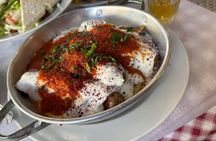
- Feast Lunch: Enjoy lamb-blend yaourtlou kebab, chicken skepasti & pork skewers with salad, tzatziki & beers—or get any meat wrapped in pita!
- Bougatsa: Crispy, golden phyllo pastry—you'll taste both traditional salty feta cheese and sweet, warm custard cream in a great combo.
- Greek Cheese & Bites: Taste aged graviera varieties and salty feta paired with crunchy rusks, spicy tirokafteri dip, and local olives.
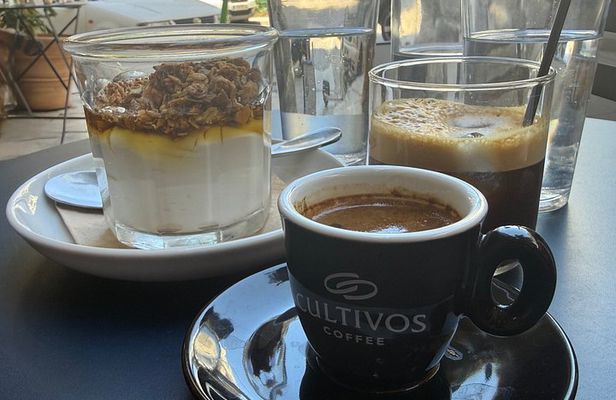
- Greek Yogurt: Creamy yogurt topped with honey and walnuts, a classic energy breakfast. Koulouri: Iconic, crisp sesame bread rings baked fresh daily, the ultimate Greek street bite.
- Freddo Espresso: Espresso shaken with ice. Freddo Cappuccino: Iced espresso topped with cold milk foam. Ellinikos: Traditional unfiltered coffee boiled in a briki.
- Bottled water
- Φιλοδωρήματα
Meeting point
Meeting point: Cultivos Coffee (Misaraliotou 1, Koukaki).
Metro (Line 2, Red): Acropolis station, walk 150m/490ft down Makrigianni St, right on Misaraliotou St.
Bus/Trolley (227, 1, 5): Makrigianni stop (100m walk).
Taxi/Uber: Drop-off directly at Misaraliotou 1.
Return details
Tour ends at Monastiraki Sq.
Metro on-site: Line 1 (Piraeus Port/Omonia) & Line 3 (Syntagma/Airport).
Taxi/Uber pickup: Athinas or Ermou St.
On foot: Plaka (5-min walk), Syntagma (10-min / 700m / 2,300ft walk down Ermou St), Psyri (across Athinas St).
- The Acropolis of Athens is the ultimate symbol of Classical Greek civilization, dominating the city's skyline from its 150-meter rocky outcrop. Built primarily during the 5th century BC Golden Age under Pericles, the complex was designed by master architects Iktinos and Kallikrates and sculpted by Phidias to showcase Athenian wealth, power, and devotion to Athena. The sanctuary features the iconic Parthenon, built with flawless Pentelic marble and optical illusions to appear perfectly straight. Surrounding it are the monumental Propylaea gateway, the delicate Temple of Athena Nike, and the Erechtheion, famous for its Caryatid porch where six draped maiden statues serve as structural columns. Having survived bombardment, Venetian ammunition explosions, Ottoman occupation, and centuries of looting, this UNESCO World Heritage Site remains an unmatched architectural triumph and the foundational cradle of Western democracy and philosophy. (pass by)
- The Choragic Monument of Lysicrates, erected in 335 BC near the Acropolis, is the world’s first known building to use the Corinthian order on its exterior. Built by a wealthy patron named Lysicrates, it served as a grand pedestal for a bronze tripod trophy won by his choir in the annual theatrical competitions at the nearby Theater of Dionysus. Constructed of Pentelic marble and porous stone, the cylindrical monument features a carved frieze depicting scenes from the myth of Dionysus transforming Tyrrhenian pirates into dolphins. Topped by a carved marble acanthus flower that once supported the prize tripod, the structure stands nearly 9 meters tall along the ancient Street of the Tripods. In the 17th century, the monument was integrated into a Capuchin monastery where Lord Byron famously wrote poetry inside its hollowed chamber. Having survived centuries of war, earthquakes, and urban development, it remains the best-preserved choragic monument from classical antiquity. (pass by)
- Hadrian's Arch is a monumental gateway built in 131–132 AD by the Athenians to honor Roman Emperor Hadrian, a dedicated benefactor of the city. Constructed entirely of fine Pentelic marble without mortar, using iron clamps, it stands 18 meters high on the ancient road that linked the historic Greek city with the newly expanded Roman quarter. The monument's most famous feature is its two opposing inscriptions carved on the architrave: the west side facing the Acropolis reads "This is Athens, the ancient city of Theseus," while the east side facing the Temple of Olympian Zeus reads "This is the city of Hadrian, and not of Theseus." Architecturally, it combines a traditional Roman triumphal arch at the base with a Greek-style Corinthian propylaeum on the upper tier. It was designed to showcase Hadrian’s grand vision of transforming Athens into the cultural capital of the Empire while honoring its legendary past. (pass by)
- The Temple of Olympian Zeus, or Olympeion, stands as a colossal monument to ancient megalomania and patience, taking a staggering 638 years to complete. Construction was initiated in the 6th century BC by the Athenian tyrant Peisistratos, but the ambitious project was repeatedly abandoned—deemed too tyrannical and financially absurd by democratic Athens—until Roman Emperor Hadrian finally completed it in 131 AD. In its prime, this staggering sanctuary was the ultimate display of architectural firepower, featuring 104 towering Corinthian columns, each standing 17 meters high. Inside, it housed a colossal statue of Zeus, directly alongside an equally massive statue of Hadrian himself—an unmissable political statement equating imperial Roman authority with divine rule. Though earthquakes, and time reduced the site to just 15 standing columns (with a 16th dramatically fallen during an 1852 storm), the remaining ruins near Hadrian's Arch offer an impressive look at ancient engineering. (pass by)
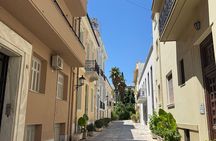
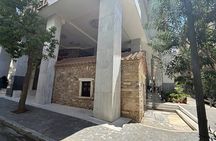
- Plaka, known as the "Neighborhood of the Gods," is the oldest continuously inhabited section of Athens, tucked directly beneath the eastern and northern slopes of the Acropolis. Built over the residential quarters of ancient Athens, the area retains its labyrinthine, 19th-century layout, featuring narrow cobblestone streets, Neoclassical mansions, and Byzantine churches like the 11th-century Panagia Gorgoepikoos. Within Plaka lies Anafiotika, a micro-neighborhood built in the mid-19th century by master masons from the Cycladic island of Anafi, who replicated their home island’s whitewashed stone houses and bright blue shutters. The district also houses key historic sites, including the Roman Agora, the Tower of the Winds, and the Choragic Monument of Lysicrates, along the ancient Street of the Tripods. Despite heavy tourism, Plaka retains its historic charm, serving as a picturesque open-air museum that bridges ancient ruins, Ottoman-era architecture, and vibrant modern tavernas. (pass by)
- The Hellenic Parliament building sits directly above the Tomb of the Unknown Soldier, a cenotaph carved into the retaining wall of the parliament ramp in 1932. Designed by architect Emmanuel Lazaridis and sculpted by Fokion Rok, the monument honors all Greek soldiers who lost their lives in war, particularly those whose bodies were never identified or recovered. The central focus of the marble monument is a relief sculpture depicting a fallen ancient Greek hoplite warrior lying on a shield. Flanking the warrior are carved inscriptions of famous excerpts from Pericles' Funeral Oration, alongside the names of historical battlefields where Greek forces fought, from the Balkan Wars and World War I to World War II and Cyprus. Built from Mount Pentelicus marble, the tomb functions as the national memorial of modern Greece. It serves as the primary site for state ceremonies, military honors, and official wreath-laying visits by foreign heads of state. (pass by)
- The Changing of the Guard takes place directly in front of the Hellenic Parliament at the Tomb of the Unknown Soldier, performed by the Evzones—the elite Presidential Guard. This high-precision military ritual symbolizes perpetual vigilance over Greece's fallen soldiers, executed in complete silence with deliberate, slow-motion high kicks and metallic boot strikes designed to honor the dead. The guards wear traditional handcrafted uniforms, featuring the fustanella (a white kilt with 400 pleats representing the 400 years of Ottoman occupation) and tsarouchia (heavy leather shoes fitted with iron nails and silk pom-poms). Each hour-long post requires absolute immobility, with guards standing completely motionless regardless of weather conditions. (pass by)
- The Varvakios Central Market (Varvakeios Agora), operating on Athinas Street since 1886, is the bustling culinary heart of Athens. Designed by architect Ioannis Koumelis following a devastating fire in the city’s older market area, the iron-and-glass glass roof structure was built to establish a modern, sanitary covered market for meat, fish, and produce. Named after Ivan Varvakis—a Greek national benefactor, privateer, and caviar tycoon who funded its construction—the market remains the epicenter of daily Athenian gastronomy. Inside its glass-roofed hall, vibrant fishmongers and butchers sell alongside traditional spice shops and historic koutoukia (underground taverns) serving classic dishes like patsas (tripe soup) to locals and night owls alike. Surviving decades of urban evolution, Varvakeios offers an authentic, high-energy look at everyday Greek food culture. It stands as a vibrant landmark bridging historic 19th-century trade with the living culinary traditions of modern Athens (pass by)
If it’s canceled due to poor weather, you’ll be offered a different date or a full refund.
If it’s canceled because the minimum isn’t met,
you’ll be offered a different date/experience or a full refund.
How it works?
01
—
You choose from 10,000+ experience gifts
02
—
We deliver the eVoucher or the Physical box to the recipient
03
—
Recipient books the experience and creates unforgettable memories!
Beat The Heat in Athens Local Food and Sightseeing Walking Tour
Athens, Greece, Europe
$90.31
This is an experience gift voucher. The recipient will book the experience after
they redeem the gift voucher.
How it works?
01
—
You choose from 10,000+ experience gifts
02
—
We deliver the eVoucher or the Physical box to the recipient
03
—
Recipient books the experience and creates unforgettable memories!