



No expiration date
Easy refund
Free exchange
Easy booking
Full Coverage Istanbul Walking Tour
 Istanbul, Turkey, Europe
$156.94
This is an experience gift voucher. The recipient will book the experience after
they redeem the gift voucher.
Overview
The Full Coverage Istanbul Walking Tour showcases the rich history and culture of Istanbul through iconic landmarks and hidden gems. Enjoy a comprehensive exploration of this vibrant city in just five hours.
- 🏛️ Guided exploration of significant historical landmarks with expert storytelling that brings the past to life.
- 🌆 Panoramic views from the Galata Tower, one of the city's most recognizable structures, enhance your experience.
- 🎨 Visit the Pera Museum, where art and history converge, showcasing outstanding collections.
- 🕰️ The itinerary may vary based on conditions, ensuring a dynamic experience tailored to the day.
- 💡 Wheelchair accessible, with all areas and surfaces designed for easy navigation, making it suitable for everyone.
- 🚆 Convenient public transportation options nearby allow for easy access to the tour starting point.
- 👟 Comfortable walking shoes are recommended to make the most of the extensive walking involved.
- 💬 Professional guidance is provided, ensuring you gain in-depth knowledge of each location visited.
- 💰 All local taxes and tips are included, offering a hassle-free experience.
- 🎟️ Entry admissions to all sites are covered, allowing you to focus on enjoying the journey.
By choosing Tinggly, you embrace a sustainable gifting option that offers instant digital delivery, no expiration on vouchers, and a world of experiences to choose from.
—
Full Coverage Istanbul Walking Tour
Tour guide
Language: English
Human tour guide
Duration: 5 hours
- Professional Guidance
- All Local Taxes
- Tips
- Entry Admissions
Meeting point
Sultanahmet Square, next to the German Fountain which is next to the Blue Mosque.
Return details
Very common meeting point in modern city
-
Hagia Sophia Grand MosqueIn 537 AD, Emperor Justinian walked into the newly finished Hagia Sophia and reportedly said, "Solomon, I have surpassed you" — a reference to the Temple in Jerusalem. The dome had never been built that large before; it was an engineering gamble that partially collapsed twice. What stands today is the third attempt. Byzantine mosaics, Islamic calligraphy, and Ottoman additions were each layered on top of the last. This building didn't just witness history — it was history's address.
- In 1728, Sultan Ahmet III had this fountain built as a statement. The Tulip Era — his era — was Ottoman Istanbul at its most extravagant: European fashions, tulip gardens, poetry nights on the Bosphorus. The fountain offered free sherbet to anyone passing by. Three years later, a rebellion ended it all. The Sultan was dethroned. The tulips were torn up. But the fountain stayed — a marble footnote to one of history's most flamboyant and abruptly finished reigns. (pass by)
- Most people walk past Hagia Irene without stopping — which is remarkable, because this is where early Christianity nearly tore itself apart. Theological wars over the nature of Christ raged within these walls for decades. Hagia Irene — meaning Holy Peace — saw precious little of it. Unlike every other Byzantine church in the city, the Ottomans never converted it to a mosque; they used it as an armory instead. The cannonballs are long gone. The silence they left behind is something else entirely. (pass by)
-
TopkapI PalaceFor 400 years, every decision shaping three continents was made inside these walls. Topkapı wasn't a palace — it was a city within a city, home to 4,000 people at its peak: sultans, concubines, eunuchs, janissaries, and an entire empire's bureaucracy. The Harem alone had 300 rooms. Suleiman the Magnificent walked these courtyards. So did Roxelana — the slave who became his legal wife and arguably the most powerful woman in Ottoman history. Power always leaves a residue. You can feel it here.
- In 1887, Ottoman archaeologist Osman Hamdi Bey excavated Sidon in modern Lebanon and returned with something extraordinary — a sarcophagus carved with such precision that historians initially assumed it belonged to Alexander the Great. It doesn't, but the true story of its owner is just as remarkable. The same museum also holds a 3,300-year-old clay tablet recording the world's oldest surviving peace treaty, between Egypt and the Hittites. Most of recorded civilization passed through this city. The proof is in here. (pass by)
-
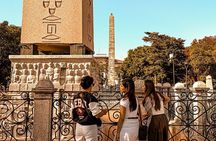
Hippodromen 532 AD, a chariot-racing rivalry between two fan factions escalated into the Nika Riots — five days of violence that burned half of Constantinople and killed 30,000 people. Emperor Justinian nearly fled. His wife Theodora stopped him, saying she would rather die in imperial purple than live in exile. He stayed. The rioters were lured into this very stadium and massacred. The three ancient monuments still standing here — the Egyptian Obelisk, Serpent Column, and Column of Constantine — watched all of it.
-
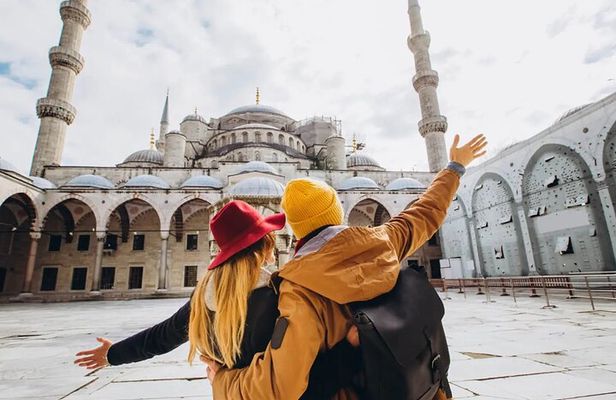
Blue MosqueSultan Ahmet I was 19 when he commissioned this mosque in 1609. He had never won a war — unusual for an Ottoman sultan — and building directly opposite Hagia Sophia was partly compensation, partly ambition. He demanded six minarets, which scandalized the Islamic world: only Mecca's mosque had six. He quietly funded a seventh minaret for Mecca to end the controversy. Ahmet died at 27, just a year after the mosque's completion. He is buried in a mausoleum just outside the wall he never lived to see finished.
-
Corlulu Ali Pasa MedresesiCorlulu Ali Pasha served as Grand Vizier under three sultans, survived palace intrigues that finished most men, and built this courtyard complex in the early 1700s. He was eventually executed anyway — that was the standard fate of Grand Viziers who fell from favor. His complex became a madrassa, then a caravanserai, and today it's one of the few corners of the old city where you can sit under plane trees, drink tea, and watch time pass without anyone trying to sell you something.
-
Grand BazaarThe Grand Bazaar didn't begin as a market. Mehmed II built a small stone bedesten — a lockable vault for storing valuables — shortly after conquering Constantinople in 1453. Merchants clustered around it. Then more merchants, then hans, coffee houses, mosques, and fountains. Over 500 years it expanded organically into 61 streets and 4,000 shops. It has burned and been rebuilt multiple times, because trade could not stop. Some families have held the same shop for generations. The commerce never paused long enough for them to leave.
-
Misir CarsisiThe name means Egyptian Market — not because it sold Egyptian goods, but because it was built using tax revenues collected from Egypt, then an Ottoman province. Completed in 1664, the income from these shops funded the upkeep of the Yeni Mosque next door. That arrangement — commerce sustaining religion — was very Ottoman. The spice trade filling these vaulted corridors once moved the entire global economy. Today the same stalls sell saffron, sumac, and Turkish delight. The scale changed. The smell hasn't.
- There have been five bridges on this spot. The first was a pontoon of lashed boats. Leonardo da Vinci submitted a design for a replacement in 1502 — it was rejected. Michelangelo was also approached and declined. The current bridge opened in 1994. Beneath its deck, restaurants hang over the water. Above, fishermen line the railings at all hours. The Golden Horn it spans was the very harbor the Byzantines blocked with a great chain in 1453 — and which the Ottomans bypassed by dragging their warships overland. (pass by)
- In 1906, Ottoman painter Osman Hamdi Bey completed The Tortoise Trainer — a man coaxing tortoises with a flute. It sounds whimsical. It was not. Hamdi Bey was arguing that the Ottoman world was not static or backward — it was being guided somewhere. He was also the man who passed the law banning antiquities from leaving the country, which is why Istanbul's museums are as rich as they are. His painting anchors Pera Museum's collection. Both the art and the argument it was making still hold up. (pass by)
-
Avrupa PasajiBuilt in 1870, Avrupa Pasajı was designed for the European merchants and diplomats who filled Pera — then the cosmopolitan quarter where Greeks, Armenians, Jews, Levantines, and Western Europeans lived side by side under Ottoman rule. Its iron-and-glass structure was borrowed directly from Parisian arcades. The embassies are mostly gone now. Those communities were scattered across the 20th century by war, taxation, and population exchanges. The architecture stayed. Walk through slowly — the building remembers what the city prefers to forget.
-
Cicek Pasajithe Flower Passage — got its name from White Russian refugees who sold flowers here after fleeing the 1917 revolution. Before that it was a grand 1876 arcade called the Cité de Péra. It fell into beautiful ruin, became a corridor of meyhanes and working-class taverns, was restored in the 1980s, and now exists somewhere between both versions of itself. Writers, fishmongers, opera singers, and exiles all passed through. Order a rakı at one of the tavern tables. Some traditions deserve to continue.
-
St Antoine Catholic ChurchSt. Antoine was built by the Franciscans on a street that was once the most cosmopolitan avenue in the Islamic world. İstiklal — then called the Grand Rue de Péra — was lined with European embassies, theaters, and patisseries. St. Antoine served the Italian community; nearby stood Greek Orthodox, Armenian, and Jewish congregations. That pluralism was deliberate — the Ottomans strategically settled different communities in designated neighborhoods. İstiklal still carries that layered identity today, even as the communities themselves have thinned.
-
Galata TowerThe Genoese built Galata Tower in 1348 as the centerpiece of their fortified trading colony — a self-governing enclave operating under its own laws, entirely separate from Byzantine Constantinople across the water. After the Ottoman conquest it served as prison, observatory, and — according to the Ottoman historian Evliya Çelebi — the launch point of Hezarfen Ahmet Çelebi, who allegedly strapped on wings in 1638 and glided from the tower clear across the Bosphorus. Whether true or not, Istanbul claimed the story as its own. That alone tells you something.
How it works?
01
—
You choose from 10,000+ experience gifts
02
—
We deliver the eVoucher or the Physical box to the recipient
03
—
Recipient books the experience and creates unforgettable memories!
Full Coverage Istanbul Walking Tour
Istanbul, Turkey, Europe
$156.94
This is an experience gift voucher. The recipient will book the experience after
they redeem the gift voucher.
How it works?
01
—
You choose from 10,000+ experience gifts
02
—
We deliver the eVoucher or the Physical box to the recipient
03
—
Recipient books the experience and creates unforgettable memories!