

No expiration date
Easy refund
Free exchange
Easy booking
Tokyo Customized Tour & Rickshaw with Licensed Guide
 Tokyo, Kanto, Japan
$310.61
This is an experience gift voucher. The recipient will book the experience after
they redeem the gift voucher.
Overview
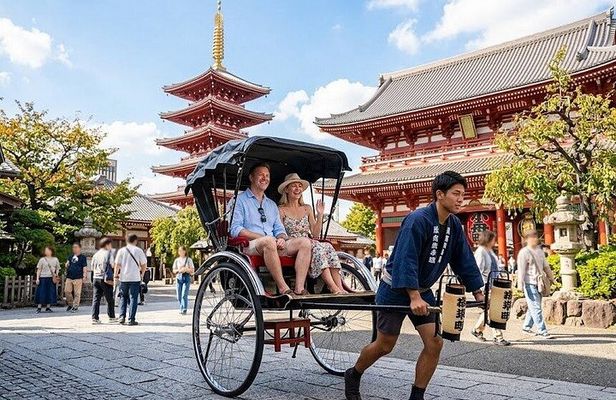
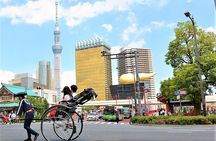
This 6 hour Tokyo walking tour includes a 30minute rickshaw ride in historical and modern Asakusa!
Rickshaws were invented in Japan in the late 19th century and were once a popular form of transport. Riding on a traditional Japanese Rickshaw with scenic views and a friendly driver is one of the most popular activities in Tokyo! Your tour will also include a walking tour with one of our guides. You will be able to visit about 2 to 3 sights of your choice on this tour. Please see itinerary for possible sights.
Riding time: 30 minutes.
Area and route: Within Asakusa
Number of riders per rickshaw: 2 people. A group of 3 or more will be split into separate rickshaws.
Your guide will drop you off at Jidaiya after a 5-hour walking tour. Start time: Your start time for the experience may vary. The estimated time for the experience will be about 5 hours from the start of the tour.
Note: Infants who cannot hold up their own heads and pregnant women are not allowed to ride on a rickshaw.
—
Tokyo Customized Tour & Rickshaw with Licensed Guide
Pickup included
Pickup included
Tour guide
Language: English
Human tour guide
Duration: 6 hours
- Licensed Local English Speaking Guide
- Customizable Tour of your choice of 2-3 sites from 'Itinerary' list
- Riding a rickshaw experience
- Meet up with guide on foot within designated area of Tokyo
- Guide Entry fees are only covered for sights listed under 'Itinerary' list.
- You cannot combine multiple tour groups.
- The Kimono
- Private Vehicle
- Transportation fees, Entrance fees, Lunch, and Other personal expenses
-
Jidaiya's Japanese culture experience programs are for those seeking for a good alternative of Asakusa sightseeing and for the people who wish to have more profound and authentic Japanese experience.
-
AsakusaAsakusa is the center of Tokyo's shitamachi (literally "low city"), one of Tokyo's districts, where an atmosphere of the Tokyo of past decades survives. Asakusa's main attraction is Sensoji, a very popular Buddhist temple, built in the 7th century. The temple is approached via the Nakamise, a shopping street that has been providing temple visitors with a variety of traditional, local snacks and tourist souvenirs for centuries. Asakusa can easily be explored on foot.
-
Senso-ji TempleSensoji is a Buddhist temple located in Asakusa. It is one of Tokyo's most colorful and popular temples. The legend says that in the year 628, two brothers fished a statue of Kannon, the goddess of mercy, out of the Sumida River, and even though they put the statue back into the river, it always returned to them. Consequently, Sensoji was built nearby for the goddess of Kannon. The temple was completed in 645, making it Tokyo's oldest temple.
-
Tsukiji Fish MarketExplore the old fish market in Tokyo!
-
Meiji Jingu ShrineMeiji Shrine (明治神宮, Meiji Jingū) is a shrine dedicated to the deified spirits of Emperor Meiji and his consort, Empress Shoken. Located just beside the JR Yamanote Line's busy Harajuku Station, Meiji Shrine and the adjacent Yoyogi Park make up a large forested area within the densely built-up city. The spacious shrine grounds offer walking paths that are great for a relaxing stroll. The shrine was completed and dedicated to the Emperor Meiji and the Empress Shoken in 1920, eight years after the passing of the emperor and six years after the passing of the empress. The shrine was destroyed during the Second World War but was rebuilt shortly thereafter.
-
Shinjuku Gyoen National GardenShinjuku Gyoen is one of Tokyo's largest and most popular parks. Located a short walk from Shinjuku Station, the park's spacious lawns, meandering walking paths and tranquil scenery provide a relaxing escape from the busy urban center around it. In spring Shinjuku Gyoen becomes one of the best places in the city to see cherry blossoms. Adults \500 (Group discount \400) Seniors (65 and over) \250 ※Valid ID required. Please purchase a ticket at a staffed counter. Students \250 ※Valid Student ID required. Please purchase a ticket at a staffed counter. Children (junior high school students /15 and under) FREE
-
Koishikawa Korakuen GardenKoishikawa Korakuen is one of Tokyo's oldest and best Japanese gardens. It was built in the early Edo Period (1600-1867) at the Tokyo residence of the Mito branch of the ruling Tokugawa family. Like its namesake in Okayama, the garden was named Korakuen after a poem encouraging a ruler to enjoy pleasure only after achieving happiness for his people. Koishikawa is the district in which the garden is located in. Admission fee Adult: 300 JPY Children and senior (+65): 150 JPY
-
Hamarikyu GardensHama Rikyu is a large, attractive landscape garden in central Tokyo. Located alongside Tokyo Bay, Hama Rikyu features seawater ponds which change level with the tides, and a teahouse on an island where visitors can rest and enjoy the scenery. The traditionally styled garden stands in stark contrast to the skyscrapers of the adjacent Shiodome district. Admission fee Adult: 300JPY Senior(+65): 150JPY Children 12 and under: Free
-
Imperial Palace**This tour does not include access to the inside of the Imperial Palace** The current Imperial Palace is located on the former site of Edo Castle, a large park area surrounded by moats and massive stone walls in the center of Tokyo, a short walk from Tokyo Station. It is the residence of Japan's Imperial Family. Edo Castle used to be the seat of the Tokugawa shogun who ruled Japan from 1603 until 1867. In 1868, the shogunate was overthrown, and the country's capital and imperial residence were moved from Kyoto to Tokyo. In 1888 construction of a new Imperial Palace was completed. The palace was once destroyed during World War Two, and rebuilt in the same style, afterwards.
-
Rikugien GardenRikugien is often considered Tokyo's most beautiful Japanese landscape garden alongside Koishikawa Korakuen. Built around 1700 for the 5th Tokugawa Shogun, Rikugien literally means "six poems garden" and reproduces in miniature 88 scenes from famous poems. The garden is a good example of an Edo Period strolling garden and features a large central pond surrounded by manmade hills and forested areas, all connected by a network of trails. Admission fee Adult: 300 JPY Senior(+65): 150 JPY Children (12 and under): Free
-
AkihabaraAkihabara (秋葉原), also called Akiba after a former local shrine, is a district in central Tokyo that is famous for its many electronics shops. In more recent years, Akihabara has gained recognition as the center of Japan's otaku (diehard fan) culture, and many shops and establishments devoted to anime and manga are now dispersed among the electronic stores in the district. On Sundays, Chuo Dori, the main street through the district, is closed to car traffic from 13:00 to 18:00 (until 17:00 from October through March).
-
Takeshita StreetHarajuku (原宿) refers to the area around Tokyo's Harajuku Station, which is between Shinjuku and Shibuya on the Yamanote Line. It is the center of Japan's most extreme teenage cultures and fashion styles, but also offers shopping for adults and some historic sights. The focal point of Harajuku's teenage culture is Takeshita Dori (Takeshita Street) and its side streets, which are lined by many trendy shops, fashion boutiques, used clothes stores, crepe stands and fast food outlets geared towards the fashion and trend conscious teens.
-
NezuHaving miraculously avoided major damage during world wars and natural disasters, Yanaka and Nezu—two of the neighborhoods that make up shitamachi, Tokyo's old downtown—retain their last-century charm. You'll find historical sites such as Yanaka Cemetery and Nezu Shrine tucked away among shitamachi's narrow back alleys, traditional wooden houses, izakaya pubs, atmospheric coffee shops and retro stores selling old-style sweets and snacks. Here you can slip back in time to a slower-paced, more genteel Tokyo.
-
Godzilla RoadNear the famous Japanese style bar district of Golden Gai, you can see Godzilla towering over Shinjuku! This area is very busy and full of night life shops but also boasts many arcades nearby and the new Kabukicho building with a Japanese outdoor style restaurants inside. Clean and visitor friendly!
How it works?
01
—
You choose from 10,000+ experience gifts
02
—
We deliver the eVoucher or the Physical box to the recipient
03
—
Recipient books the experience and creates unforgettable memories!
Tokyo Customized Tour & Rickshaw with Licensed Guide
Tokyo, Kanto, Japan
$310.61
This is an experience gift voucher. The recipient will book the experience after
they redeem the gift voucher.
How it works?
01
—
You choose from 10,000+ experience gifts
02
—
We deliver the eVoucher or the Physical box to the recipient
03
—
Recipient books the experience and creates unforgettable memories!