

No expiration date
Easy refund
Free exchange
Easy booking
Spanish Civil War Walking Tour
 Madrid, Spain, Europe
$33.22
This is an experience gift voucher. The recipient will book the experience after
they redeem the gift voucher.
Overview
Discover the hidden scars of Madrid and relive the dramatic story of the Spanish Civil War (1936–1939). From royal bombings to underground resistance, this tour reveals how the city lived, fought, and survived under fire.
In a city with no plaques, no monuments, and no official museums about the war, we’ll uncover a past deliberately silenced — walking through places where history was written and erased at the same time.
We’ll visit Calle Mayor, Puerta del Sol, Gran Vía, and Plaza de España, tracing the stories of Hemingway, Gerda Taro, spies, and ordinary Madrileños who endured hunger, fear, and the bombings of Hitler’s Condor Legion.
The tour ends at the Temple of Debod, where beauty and tragedy meet — the site of one of Madrid’s first battles.
A powerful journey through memory and survival — perfect for history lovers and curious travelers who want to see what remains unseen.
In a city with no plaques, no monuments, and no official museums about the war, we’ll uncover a past deliberately silenced — walking through places where history was written and erased at the same time.
We’ll visit Calle Mayor, Puerta del Sol, Gran Vía, and Plaza de España, tracing the stories of Hemingway, Gerda Taro, spies, and ordinary Madrileños who endured hunger, fear, and the bombings of Hitler’s Condor Legion.
The tour ends at the Temple of Debod, where beauty and tragedy meet — the site of one of Madrid’s first battles.
A powerful journey through memory and survival — perfect for history lovers and curious travelers who want to see what remains unseen.
—
Madrid Civil War Walking Tour with Local Expert
Tour guide
Language: English
Human tour guide
Duration: 2 hours
- Guided walking tour with a cultural journalist
- Food, drinks and transport.
Meeting point
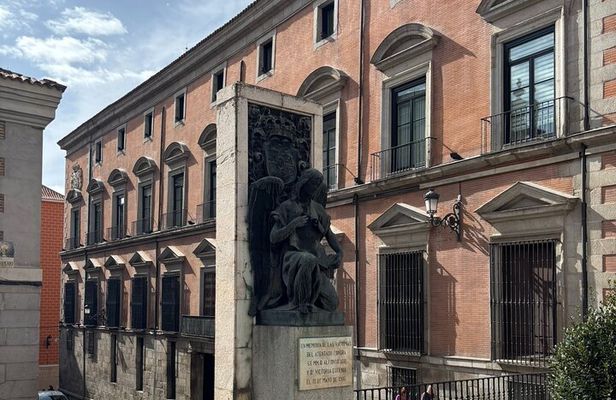
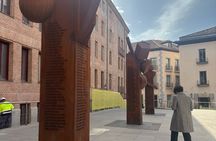
At the Monument to the Victims of the Attack against King Alfonso XIII. Next to the Palace of Councils, on the sidewalk across from Casa Ciriaco restaurant.
Return details
-
Calle MayorMonument to the Victims of Alfonso XIII. We’ll begin by talking about the atmosphere of violence and political tension that preceded the Spanish Civil War, a country deeply divided long before 1936. Here we’ll recall the attack against King Alfonso XIII in 1906, carried out by the anarchist Mateo Morral. The bomb, hidden in a bouquet of flowers, exploded as the royal carriage passed by after the king’s wedding, killing dozens of civilians. It was an early sign of the instability, resentment, and class conflict that would later tear Spain apart.
-
Plaza de la VillaMonument to the Victims of Mauthausen. This moving monument honors the Spanish Republicans who were exiled after the Civil War and later became victims of Nazi persecution. Thousands were deported to concentration camps such as Mauthausen, where many perished. We’ll also talk about the Spanish diaspora — the tens of thousands who fled to France and Latin America, forced to rebuild their lives far from home. Their exile became one of the greatest human tragedies of the 20th century and a lasting wound in Spain’s collective memory.
-
Plaza de la VillaThe Mudejar style leads us symbolically to the south of Spain, where a feudal system persisted well into the 20th century. The dispute over land ownership —concentrated in the hands of the aristocracy— was one of the main causes that fueled the Spanish Civil War. We’ll also discuss the lingering shadow of the Spanish Empire and how its legacy shaped the army’s mindset: a force steeped in colonial pride, hierarchy, and a vision of Spain as a once-sacred, indivisible empire.
-
Mercado San MiguelToday this is a lively food hall full of tourists, but during the Civil War it was a real neighborhood market. We’ll talk about the hunger and scarcity of those years, when people survived thanks to ration cards and waited in endless lines outside markets like this one, hoping to find a little bread, oil, or whatever food was available.
-
Calle MayorIn the lower part of Calle Mayor, we’ll see the scars left by a bomb dropped by the Nazis in August 1936. Madrid was one of the first European cities to be bombed from the air. Today, the city has erased most traces of the war, but here we can still glimpse a fragment of its devastating past.
-
Puerta del SolFrom the balcony of the Casa de Correos, the Second Republic was proclaimed on April 14, 1931 — a moment of immense joy and hope for the Spanish people. Yet that same building would later become a place of terror: during the Franco dictatorship, its cellars were used as a prison and torture center by the secret police. The Casa de Correos thus tells the story of Spain’s light and darkness — the birth of freedom and the long night that followed.
-
Real Casa de PostasThis elegant 18th-century building once housed the Guardia de Asalto, the Republican police force. From here, several officers left on the night of July 12, 1936, to arrest —and ultimately murder— José Calvo Sotelo, the leader of the right-wing opposition. Franco always claimed that this assassination marked the true beginning of the Civil War. Standing here, we recall how a single act of violence helped ignite one of the darkest chapters in Spain’s history.
-
Iglesia de Nuestra Senora del Carmen y San LuisThe burning of churches by Republican militias across Spain —including in Madrid— was one of the most painful and controversial episodes of the Civil War. Religious buildings, seen by many as symbols of privilege and oppression, became targets of popular fury. This particular church witnessed a scandalous event: a group of young left-wing activists organized a wild party inside its walls, turning a sacred place into a scene of provocation and chaos. It stands today as a reminder of how hatred and despair can desecrate even the most sacred spaces.
-
Plaza del CallaoIn this square once stood the legendary Hotel Florida, where international correspondents such as Ernest Hemingway, Martha Gellhorn, Robert Capa, Gerda Taro, and Antoine de Saint-Exupéry lived and wrote during the war. It was the heart of foreign journalism in besieged Madrid — a place of typewriters, cigarette smoke, and courage under fire. Just beside it, the Callao Cinema, one of the oldest in the city, reminds us that going to the movies was one of the few comforts for Madrileños during those dark years. Callao was also the stage for the first parade of the International Brigades, the volunteers from all over the world who came to defend the Republic.
-
Gran ViaBuilt in the 1920s as Madrid’s own Broadway, Gran Vía symbolized progress and modern life — lined with cinemas, theaters, and elegant cafés. But during the Civil War, it became one of the most bombed streets in the city. Hitler’s Condor Legion, supporting Franco, launched repeated air raids over Madrid, and Gran Vía earned the grim nickname “Avenida de las Bombas.” In nearby Malasaña, home to much of the Republican-leaning middle class, entire blocks were destroyed. Once the heart of a modern, joyful capital, Gran Vía turned into the boulevard of broken dreams — a haunting reminder of how even beauty and progress can be shattered by war.
-
Capitol CinemaDuring the war, this emblematic art-deco landmark was home to Mikhail Koltsov, a Soviet journalist and political commissar who inspired one of Hemingway’s characters in For Whom the Bell Tolls. Madrid was then a true city of spies — a crossroads of secret agents, foreign correspondents, and political intrigue. Here operated Alexander Orlov, Stalin’s man in Spain, who oversaw the purges and executions of supposed traitors within the Republican ranks. Ironically, after fleeing to the United States, Orlov himself became a fugitive from Stalin’s terror — a fitting end to one of the darkest figures of that shadow war.
-
Plaza De EspanaDuring the Civil War, this square —today surrounded by skyscrapers and hotels— was transformed into a front-line battlefield. Republican artillery was installed here, with cannons aimed toward Casa de Campo and Parque del Oeste, where the fascist troops were entrenched. What is now a bustling, modern crossroads was once a devastated war zone, echoing with explosions and gunfire. Plaza de España stands today as a reminder of how the war reached the very heart of Madrid, turning its grand avenues into trenches.
-
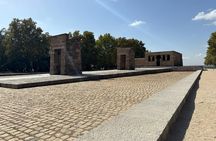
Templo de DebodWe end our tour at one of Madrid’s most beautiful and symbolic spots. The Temple of Debod, an ancient Egyptian monument gifted to Spain, stands on the very site of the Cuartel de la Montaña, where one of the war’s first great tragedies took place. In July 1936, Republican forces stormed the barracks after a bloody uprising by the rebel troops stationed there. The massacre marked the beginning of open warfare in Madrid. Today, the serenity of the temple and the magnificent views over Casa de Campo and the Royal Palace offer a moment of reflection — a place where beauty and history meet, and where we can look back on the city’s wounds with peace.
If it’s canceled because the minimum isn’t met,
you’ll be offered a different date/experience or a full refund.
How it works?
01
—
You choose from 10,000+ experience gifts
02
—
We deliver the eVoucher or the Physical box to the recipient
03
—
Recipient books the experience and creates unforgettable memories!
Spanish Civil War Walking Tour
Madrid, Spain, Europe
$33.22
This is an experience gift voucher. The recipient will book the experience after
they redeem the gift voucher.
How it works?
01
—
You choose from 10,000+ experience gifts
02
—
We deliver the eVoucher or the Physical box to the recipient
03
—
Recipient books the experience and creates unforgettable memories!